
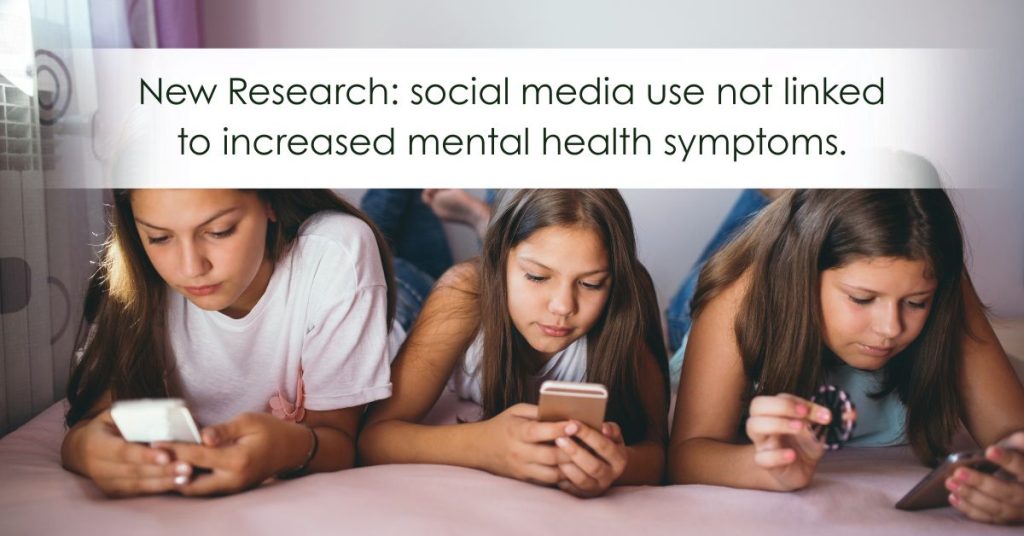
New data suggests that 'adolescents who are already struggling emotionally are more likely to increase their screen use.'
In a new study titled "How do social media use, gaming frequency, and internalizing symptoms predict each other over time in early-to-middle adolescence?" researchers explored the relationship between digital technology use and mental health (specifically anxiety and depression).
Main Findings
1. The "Uses and Gratifications" Pathway (Mental Health >Tech Use)
The study's most consistent finding was that internalising symptoms (anxiety/depression) predicted future increases in social media use. * Adolescents with higher levels of emotional distress were more likely to turn to social media over time, likely as a coping mechanism, a way to seek social support, or to escape negative feelings.
2. The "Displacement/Effect" Pathway (Tech Use > Mental Health)
Contrary to popular narratives that social media causes mental health decline, the study found no significant evidence that social media use predicted a subsequent increase in internalising symptoms. * Spending more time on social media did not lead to higher levels of anxiety or depression later on in this specific sample.
3. The Role of Gaming
The relationship between gaming and mental health was largely non-significant in both directions.
- Gaming frequency did not predict future mental health issues, nor did mental health issues consistently predict changes in gaming habits.
4. Active vs. Passive Use
The study explored whether "active" use (posting, chatting) versus "passive" use (scrolling, browsing) changed the outcome. However, the findings suggested that the total time spent on social media was the more relevant factor in the context of it being a response to internalising symptoms.
The authors conclude that the relationship between digital technology and adolescent mental health is not a simple case of "screens cause depression." Instead, the data suggests that adolescents who are already struggling emotionally are more likely to increase their social media use. Consequently, the study suggests that public health efforts should focus less on broad "screen time" restrictions and more on supporting the underlying mental health needs of adolescents who may be using these platforms to cope with distress.
The Symptom or the Source? Rethinking the Social Media Narrative in UK Schools
The headlines surrounding adolescent mental health in the UK have followed a familiar, linear script: Social media use is rising; mental health is declining; therefore, social media must be the cause. This narrative has fuelled national debates, from the recent EPI reports to current discussions about banning smartphones in schools.
However, this longitudinal study by Cheng et al. (2025), involving over 25,000 UK teenagers, has turned this logic on its head. The data suggests that we may have been confusing the "smoke" for the "fire."
The Directional Shift: Why "Causes" Matter
The core finding of the Cheng et al. study is a lack of evidence for the "Displacement Hypothesis"—the idea that social media causes future mental health issues. Instead, the researchers found strong evidence for the "Uses and Gratifications" model.
- The Finding: Increased social media use did not predict a rise in anxiety or depression a year later.
- The Twist: High levels of pre-existing internalising symptoms (anxiety and low mood) did predict a significant increase in social media use over time.
If students are flocking to TikTok or Instagram because they are already distressed, then treating the phone as the primary "toxin" is a fundamental diagnostic error. As discussed in our feature on Key Drivers of Young People’s Mental Health, the true catalysts—poverty, exam pressure, and isolation—are often what drive students toward digital "escape" or support-seeking in the first place.
Re-evaluating the School "Phone Ban"
The debate over Mobile Phones in Schools often centers on removing distractions to protect well-being. While a ban may improve classroom focus and reduce immediate incidents of cyberbullying, the Cheng et al. data suggests it is unlikely to "cure" the underlying mental health crisis.
If a student is using social media as a coping mechanism for internalising symptoms, a school-day ban only masks the symptom during school hours. Without a corresponding increase in pastoral support, we risk removing a student’s perceived lifeline (no matter how flawed that lifeline may be) without addressing the distress that made them reach for it.
Cognitive Impact vs. Emotional Intent
We previously explored how Social Media Use Links to Lowered Cognitive Performance, noting that heavy use can disrupt focus and sleep. The new research doesn't necessarily disprove this; rather, it adds a motivational layer.
A student’s declining cognitive performance might be the result of a "digital feedback loop":
- Distress: A student feels anxious or lonely.
- Escape: They increase social media use to cope.
- Secondary Impact: The resulting "brain fog" or lack of sleep further hinders their academic performance.
By understanding that the start of this loop is emotional distress, schools can move away from punitive measures and toward proactive screening.
What This Means for UK Schools: A Strategy for 2026
The Cheng et al. study empowers Senior Mental Health Leads to advocate for a more nuanced "Whole School Approach":
- Usage as a Red Flag: Instead of seeing high screen time as a behavioral "bad habit," pastoral teams should treat it as a clinical marker. A sudden spike in digital engagement may be the first visible sign of a student’s declining mental health.
- Literacy Over Limits: Since "screen time" itself wasn't the driver of depression, our PSHE curricula should focus less on the stopwatch and more on emotional regulation. We should teach students to recognize when they are "mood-scrolling"—using tech to numb feelings rather than connect with peers.
- Supporting the Drivers: We must continue to address the structural drivers of mental health. If we fix the "fire" (the underlying causes of anxiety), the "smoke" (excessive social media use) is likely to clear on its own.
Summary Table: Shifting the Narrative
| Current Viewpoint | Evidence-Based Shift (2025/26) |
| Social media causes depression. | Depression leads to increased social media use. |
| Banning phones will improve well-being. | Banning phones improves focus, but doesn't fix anxiety. |
| Focus on "Screen Time" limits. | Focus on "Emotional Literacy" and early intervention. |
| Tech is the primary driver of the crisis. | Tech is a coping mechanism for deeper social/economic stressors. |
Don't forget that AMHIE offers training, support, resources and more as part of our free membership offer - sign up today to get a complete resource pack and ongoing support with mental health and wellbeing at your setting.