
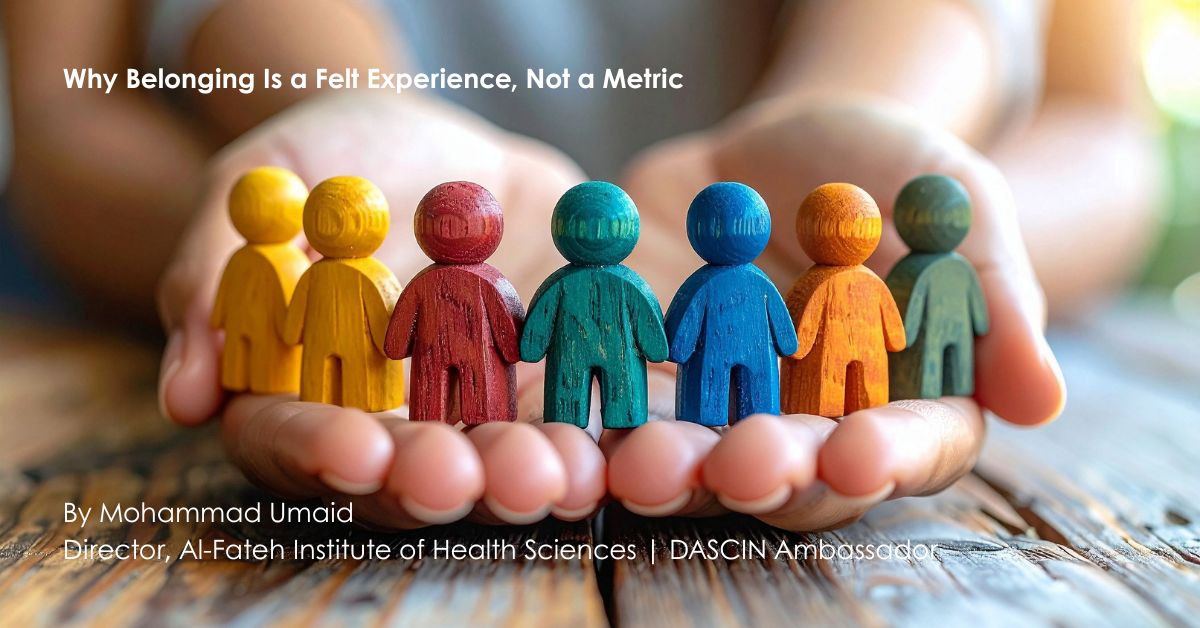
From Policy to Practice: Why Belonging Is a Felt Experience, Not a Metric
By Mohammad Umaid
Director, Al-Fateh Institute of Health Sciences | DASCIN Ambassador
Introduction
When I was invited to speak about belonging through a professional education dialogue platform, I paused.
Not because the topic felt unfamiliar — but because it felt deeply personal.
My work today sits at the intersection of healthcare education, institutional leadership, and AI governance. Yet the question that shaped my journey began much earlier:
Why does a single piece of paper so often determine a person’s sense of worth?
I now recognise that this question was never only about qualifications. It was about whether education systems truly create space for every learner to exist with dignity, possibility, and recognition.
As belonging becomes increasingly visible in education policy conversations worldwide, the challenge before us is clear:
We must move from naming belonging to designing belonging.
The Benchmark Trap: When Measurement Replaces Meaning
In AI governance, there is a recurring mistake institutions make.
Systems are deployed because they perform well on benchmarks — not because they improve human outcomes.
Education risks making the same mistake with belonging.
When inspection cycles approach, documentation increases. Indicators multiply. Evidence portfolios expand. Yet belonging quietly resists measurement because belonging behaves like trust:
The moment it becomes a target, it begins to weaken.
Instead of asking only what learners produce, institutions must begin asking:
- Does every student have at least one trusted adult relationship inside the building?
- Does each learner feel their identity is respected rather than managed?
- Can students take intellectual or emotional risks without fear of embarrassment or exclusion?
Belonging is not demonstrated through paperwork.
It is demonstrated through experience.
Redesigning the Experience — Not Just the Location
Across education systems internationally, one emerging response to behavioural distress is internal exclusion: keeping learners physically present while separating them from mainstream activity.
The intention is compassionate.
But intention alone is not inclusion.
For some learners, the building itself is where anxiety begins.
Keeping a student “on site” without redesigning their experience risks containment instead of care.
Real belonging requires institutions to redesign environments through:
- Pathway diversification so success is not defined through a single academic route
- Transitional regulation spaces so overstimulated learners can recover without leaving education entirely
- Emotion-responsive timetabling so learning capacity is recognised as dynamic rather than fixed
- Family partnership structures so familiarity extends beyond the school gate
Belonging is not physical proximity to education.
It is meaningful participation within it.
The Foundation of Student Belonging Is Staff Belonging
There is a neurological reality education systems must take seriously: students cannot experience psychological safety where educators themselves feel unseen or unsupported.
Familiarity flows through culture. And culture flows through people.
If institutions want learners to feel confident enough to explore uncertainty, ask questions, and take intellectual risks, staff must experience the same security.
This requires:
- Distributed leadership cultures where responsibility is shared rather than concentrated
- Professional supervision structures where educators are supported emotionally as well as operationally
- Governance literacy across teams so staff understand the systems shaping their work rather than feeling controlled by them
When staff belong, students notice.
Always.
A Practical Institutional Audit Framework
To move beyond aspiration, institutions need indicators that reflect lived experience rather than inspection performance.
A simple four-domain belonging audit can help schools begin:
Relational Indicator
Does every learner have at least one named trusted adult connection within the institution?
Environmental Indicator
Is there at least one psychologically safe regulation space available within each learning zone?
Curriculum Indicator
Can learners demonstrate competence through multiple pathways rather than a single performance format?
Staff Indicator
Do educators have access to structured professional reflection or supervision support?
These are not compliance measures.
They are culture measures.
And culture is where belonging lives.
Why This Matters in an AI-Enabled Education Future
As education systems increasingly adopt AI-supported decision-making tools, there is a growing risk that optimisation replaces understanding.
Benchmark-driven systems reward efficiency.
Belonging requires relationship.
If institutions optimise learning environments only for measurable outcomes, they risk unintentionally weakening the relational conditions that allow learning itself to happen.
Belonging therefore cannot sit outside governance conversations about technology.
It must sit at their centre.
Making it Real — Every Day, For Every Learner
Belonging is not created through strategy documents.
It is created through moments.
A teacher remembering a learner’s name on a difficult morning. A corridor conversation that restores confidence. A classroom where uncertainty is safe rather than punished.
Policy can define direction.
But practice defines experience.
Belonging is not a metric to report.
It is a feeling to protect.
And when institutions commit to protecting it deliberately, belonging stops being an aspiration.
It becomes a daily reality — in every classroom, for every learner.
Author Bio
Mohammad Umaid is Director of Al-Fateh Institute of Health Sciences and a DASCIN Ambassador working at the intersection of education leadership, digital transformation, and AI governance. His work focuses on building learning environments that combine technological innovation with human-centred institutional culture.
